Guided implant surgery is a modern approach to dental implant placement that focuses on accuracy, safety, and predictable results. For patients considering dental implants, understanding how guided implant surgery works can help reduce anxiety and support better decision-making. This technique uses advanced planning tools to assist dentists during implant placement, improving both precision and patient comfort.
What Is Guided Implant Surgery?
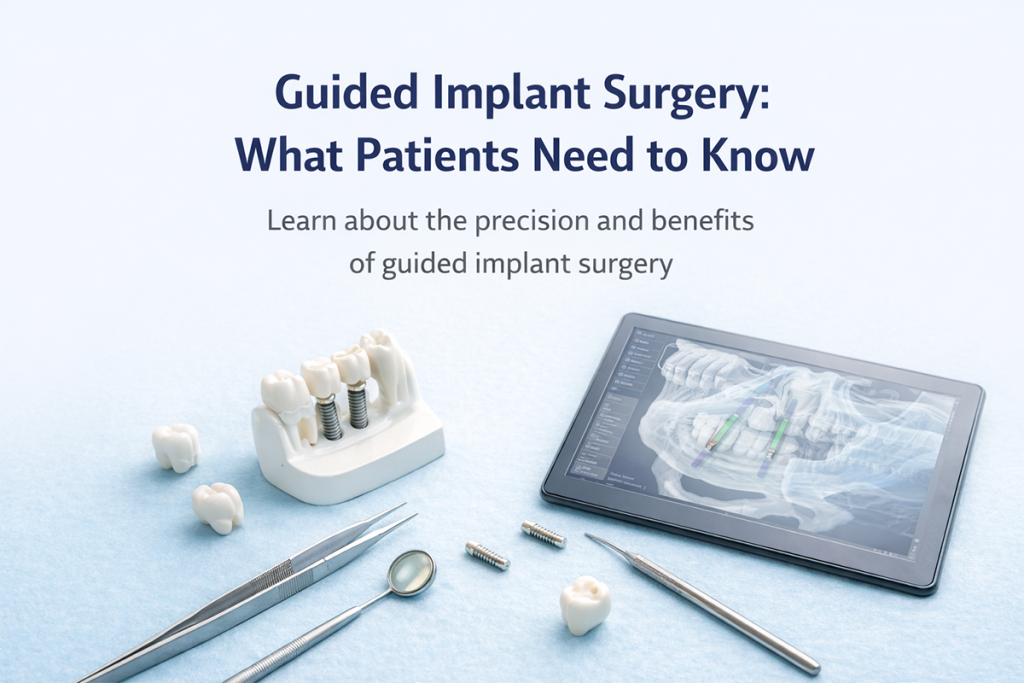
Guided implant surgery is a technique in which dental implants are placed using a pre-planned digital guide. Before the procedure, detailed scans of the patient’s jaw are taken and analyzed. Based on this data, a customized surgical guide is created to help position the implant accurately during surgery. This method allows dentists to place implants in the most optimal position while minimizing guesswork.
Unlike traditional implant placement, guided implant surgery relies on careful digital planning before the actual procedure begins. This planning stage plays a crucial role in achieving consistent and reliable outcomes.
How Guided Implant Surgery Works
The guided implant surgery process typically follows a structured sequence:
- Digital imaging and scans are taken to evaluate bone structure and oral anatomy.
- Virtual planning is done to determine the ideal implant position, depth, and angle.
- A custom surgical guide is created based on the digital plan.
- During surgery, the guide helps place the implant precisely as planned.
- Post-placement evaluation ensures stability and alignment.
This step-by-step approach helps reduce errors and enhances treatment predictability.
Benefits of Guided Implant Surgery
One of the main advantages of this implant placement method is accuracy. Because implant placement is pre-planned digitally, the risk of incorrect positioning is reduced. This can lead to better long-term outcomes and improved comfort for patients.
Other benefits include:
- Reduced surgical time
- Minimally invasive procedures
- Faster recovery in many cases
- Improved implant stability
- Better protection of surrounding tissues
These benefits make guided implant surgery a preferred option for many patients seeking dental implants.
Is Guided Implant Surgery Safe?
Guided implant surgery is considered a safe and well-established technique when performed by trained dental professionals. The digital planning phase allows dentists to identify potential challenges in advance, which helps improve safety during the procedure.
While no dental procedure is completely risk-free, the guided implant approach minimizes uncertainty by using data-driven planning. Patients are encouraged to discuss their medical history and oral health condition with their dentist to ensure suitability for this approach.
Who Can Benefit from Guided Implant Surgery?
This implant placement method can be suitable for a wide range of patients, including those who:
- Have missing teeth and adequate bone support
- Need precise implant placement due to anatomical considerations
- Prefer a minimally invasive implant procedure
However, each patient’s case is unique. A thorough dental evaluation is essential to determine whether the guided implant approach is the right choice.
What Patients Should Know Before Choosing This Method
Before opting for guided implant surgery, patients should understand the planning process involved. This technique emphasizes preparation and accuracy rather than speed. Asking questions about the procedure, recovery expectations, and long-term care can help patients feel more confident.
Patients should also be aware that the guided implant approach depends on detailed imaging and careful execution. Following post-procedure instructions is important to support healing and implant success.
Accuracy and Planning in Guided Implant Surgery
One of the key strengths of guided implant surgery lies in its emphasis on detailed planning and precision. By using digital scans and virtual simulations, dentists can evaluate bone quality, nerve positions, and surrounding structures before the actual procedure begins. This level of preparation helps reduce uncertainty during surgery and supports more predictable outcomes. Patients often benefit from this accuracy because implants are placed in positions that support proper function and long-term stability.
Another important aspect of the guided implant approach is consistency. Since the implant placement follows a pre-designed guide, the procedure is less dependent on estimation during surgery. This structured approach helps maintain accuracy even in complex cases and contributes to safer, more controlled implant placement.
Guided implant surgery offers a precise and patient-focused approach to dental implant placement. By combining digital planning with guided execution, this method helps improve accuracy, safety, and overall treatment outcomes. Understanding how guided implant surgery works allows patients to make informed choices and approach dental implant treatment with greater confidence.