
Modern dental care continues to evolve with technological innovation at its core, and digital dentistry tools are a central part of this transformation. These advanced systems are designed to enhance precision, improve patient comfort, and streamline clinical workflows. From intraoral scanners that replace messy impressions to computer-aided design and manufacturing (CAD/CAM) and guided surgical technologies, today’s tools help dentists provide care that is both efficient and highly accurate. Understanding how these technologies work and why they matter helps patients appreciate the depth of planning and precision that goes into modern treatments.
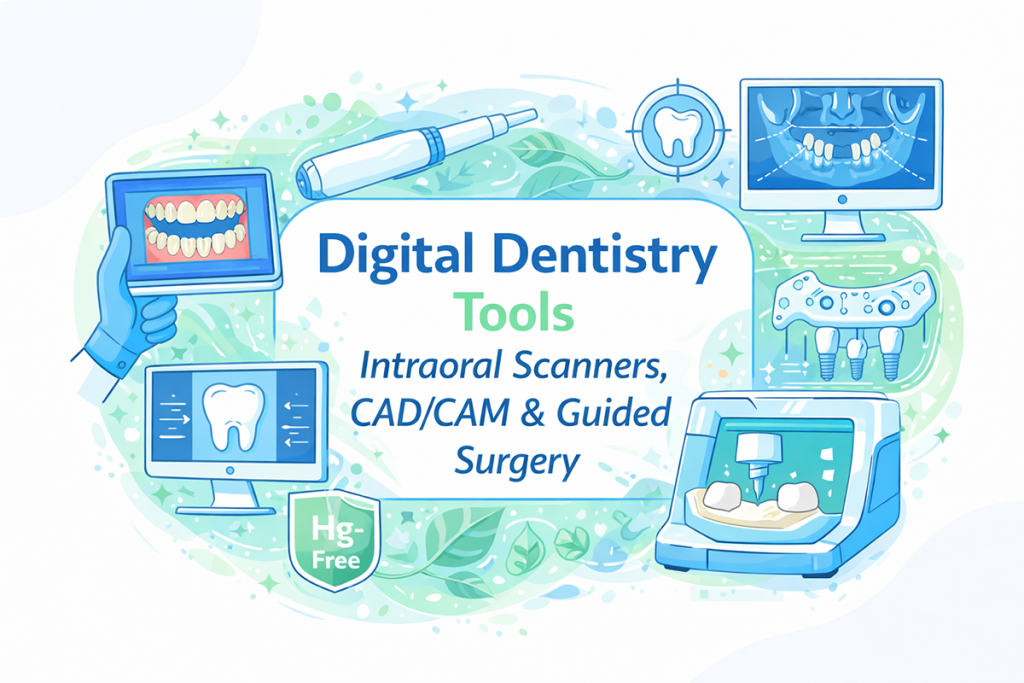
Intraoral scanners represent one of the most visible advancements among digital dentistry tools. These handheld devices capture detailed digital impressions of the teeth and gums using a small wand that moves gently inside the mouth. Unlike traditional putty impressions, digital scans are fast, comfortable, and precise. The resulting three-dimensional models can be viewed instantly on a screen, allowing both the clinician and the patient to better visualize oral structures. This improves communication, reduces discomfort, and aids in planning restorations such as crowns, bridges, or orthodontic aligners.
CAD/CAM technology builds on the digital data collected by intraoral scanners to design and fabricate dental restorations with exceptional accuracy. CAD (Computer-Aided Design) software enables dentists and technicians to create customized crowns, veneers, inlays, or onlays based on digital scans. Once the design is finalized, CAM (Computer-Aided Manufacturing) machinery mills or 3D prints the restoration from high-quality materials. The integration of these steps into a seamless digital workflow reduces turnaround times and often allows patients to receive restorations within a single visit. The precision offered by CAD/CAM not only improves fit and function but also enhances aesthetic outcomes.
Guided surgery is another area where digital dentistry tools are making a significant impact. Computer-guided systems use three-dimensional imaging to plan dental implant placement with meticulous detail. Using cone-beam computed tomography (CBCT) scans and specialized planning software, clinicians can determine the optimal implant position, angle, and depth before surgery begins. The digital plan is then translated into a surgical guide — a custom-fabricated device that fits over the patient’s teeth and guides the drilling sequence. This approach enhances safety, reduces surgical time, and increases predictability, especially in complex cases.
Digital dentistry tools also contribute to improved patient education and involvement. Visual representations of intraoral scans, CAD designs, or surgical plans help patients understand the recommended treatments. When patients can see accurate 3D models of their oral condition and proposed solutions, they are better equipped to make informed decisions. This transparency strengthens trust, increases treatment acceptance, and reduces anxiety associated with uncertainty.
Data management is another benefit of digital dentistry tools. Digital files from scanners, imaging devices, and planning software are easily stored, retrieved, and shared securely. This enhances collaboration among dental professionals, laboratories, and specialists. Digital archives also facilitate monitoring changes over time, enabling more accurate comparisons during follow-ups. Clinics that adopt these technologies gain efficiency and create comprehensive records that support long-term care.
The integration of digital dentistry tools also extends to orthodontics, where digital workflows help design clear aligners and track treatment progress. Digital scans can be used to simulate tooth movement and generate sequences of aligners customized for each treatment phase. This precise planning minimizes adjustments during appointments and helps ensure predictable outcomes. Patients appreciate the comfort of clear aligners and the clarity of visual progress models made possible through digital systems.
Another important impact of digital dentistry tools is in restorative dentistry, where precise digital planning reduces the margin for error. Accurate digital impressions and CAD/CAM-fabricated restorations fit more precisely than many traditional analog methods. This accuracy supports long-lasting restorations and minimizes the need for adjustments or remakes. Over time, this reduces chair time for patients and improves clinical efficiency for practitioners.
Beyond clinical applications, digital dentistry tools are part of a broader trend toward technology-enhanced healthcare. These systems reflect a shift from conventional techniques to workflows that leverage data, visualization, and automation. For dental professionals, this means integrating skill with digital precision. For patients, it translates into care that is faster, clearer, and often more comfortable.
As clinics continue to embrace innovation, digital dentistry tools are likely to become even more sophisticated. Advances in software algorithms, imaging quality, and machine capabilities promise to further refine treatment planning and delivery. Practices such as Lakewood Dental Smile use these technologies not to replace clinical judgment but to enhance the quality and predictability of care. For patients, the rise of digital dentistry tools means a new standard of comfort, clarity, and confidence in the treatments they receive.