Common dental treatments play a vital role in preventing, managing, and correcting a wide range of oral health problems. Teeth are exposed daily to pressure, bacteria, acids, and wear, making them vulnerable to damage and disease over time. Advances in dental science have introduced reliable tools, materials, and procedures that help restore function while improving comfort and appearance.
Dental clinics address both preventive and restorative needs through structured treatment plans. Understanding common dental treatments allows patients to feel more confident about procedures recommended by their dentist and helps them make informed decisions about oral care.
Why dental treatments are necessary
Oral health problems rarely resolve on their own. Cavities, gum disease, tooth loss, and structural damage tend to worsen if left untreated. Common dental treatments focus on stopping disease progression, relieving discomfort, and restoring normal chewing and speech functions.
Regular dental visits ensure that issues are detected early. Early treatment is often simpler, less invasive, and more cost-effective than delayed intervention.
Dental bridges
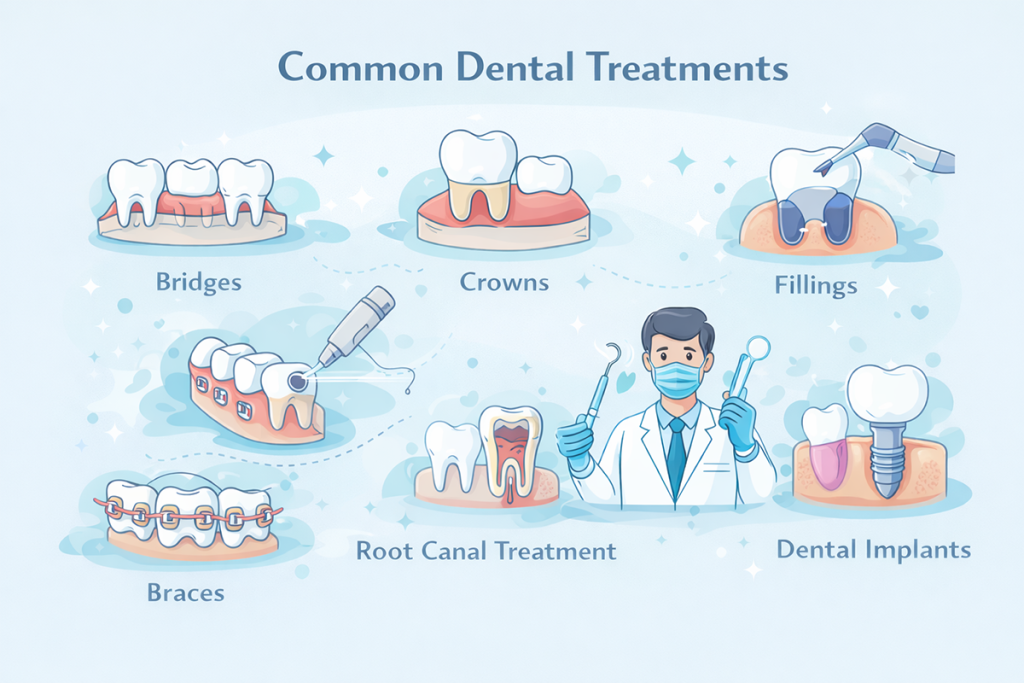
A dental bridge is used to replace one or more missing teeth. It works by anchoring an artificial tooth to the natural teeth on either side of the gap. These surrounding teeth act as supports, holding the bridge securely in place.
Among common dental treatments, bridges help restore bite alignment, prevent shifting of adjacent teeth, and improve appearance. They are typically made from porcelain, metal, or a combination of both to achieve strength and a natural look.
Dental crowns
A dental crown is a cap that completely covers a damaged or weakened tooth. Crowns are used when a tooth is broken, heavily decayed, or structurally compromised. They can also improve the shape and appearance of teeth.
Crowns are one of the most frequently performed common dental treatments because they restore strength while protecting the remaining tooth structure. Modern crowns are designed to blend seamlessly with natural teeth.
Dental fillings
Fillings are used to repair cavities caused by tooth decay. After removing the decayed portion of the tooth, the dentist fills the space with a suitable material to restore normal shape and function.
Common dental treatments often include fillings made from amalgam or tooth-colored composite materials. The choice of filling depends on the location of the cavity, durability requirements, and aesthetic considerations.
Root canal treatment
Root canal treatment addresses infection inside the tooth, where the pulp and nerves are located. Infection usually occurs due to deep decay, cracks, or trauma. Without treatment, the infection can spread and lead to tooth loss.
Among common dental treatments, root canal therapy is essential for saving natural teeth. The procedure removes infected tissue, disinfects the canal, and seals it to prevent reinfection. It may require more than one visit depending on severity.
Scaling and polishing
Scaling and polishing involve professional cleaning of the teeth. Scaling removes hardened plaque and tartar from tooth surfaces and below the gumline, while polishing smooths the teeth to reduce future plaque buildup.
This preventive procedure is one of the most basic yet important common dental treatments. Regular scaling helps prevent gum disease and supports long-term oral health.
Braces and orthodontic treatment
Braces are used to correct misaligned teeth and bite problems. They help improve appearance, chewing efficiency, and ease of cleaning. Braces may be removable or fixed, depending on treatment needs.
Orthodontic care is included among common dental treatments because misalignment can lead to uneven wear, jaw discomfort, and increased risk of decay if left untreated.
Dental implants
Dental implants are a fixed solution for replacing missing teeth. An implant is placed into the jawbone and acts as an artificial tooth root. A crown is then attached to restore function and appearance.
As one of the more advanced common dental treatments, implants help maintain bone structure and provide long-term stability. They are often chosen when removable dentures are not suitable.
Dental treatments are designed to preserve natural teeth whenever possible while restoring comfort and function. Each procedure serves a specific purpose and is recommended based on individual needs. Staying informed about common dental treatments helps patients participate actively in their oral care decisions. Clinics such as Lakewood Dental Smile emphasize preventive care and patient education as the foundation of lasting dental health.